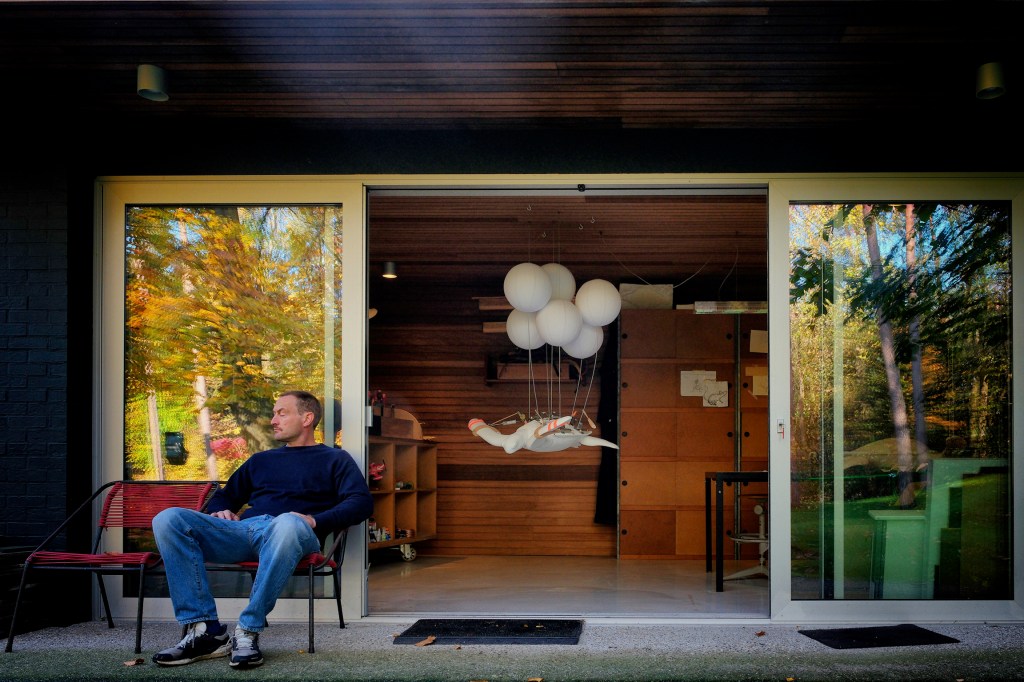
Guido KELL (1978, Belgian)
KELL was born to an engineer father and an artistic mother. From an early age, he felt an irrepressible need to create. He spent his childhood drawing, dreaming, and building in his father’s workshop, surrounded by tools and raw materials. Largely self-taught, he learned to translate his ideas into sketches and sculptures, shaping imagination into tangible form.
His work is fueled by a fascination with both nature and mechanics, exploring the fragile and often paradoxical relationship between the man-made and the natural world. This curiosity for balance, structure, and movement naturally led him to aviation. KELL became an airline pilot, convinced that “aviation is both technicality and poetry — functionality and aesthetics intertwined.”
KELL’s artistic practice is versatile and pragmatic. He carefully selects and combines materials such as paper, clay, expanding foam, wood, and metal. Found objects play a central role in his process: fragments of radio-controlled models, bicycles, antique clocks, and toys are dismantled and reassembled to serve new narratives.
His sculptures reflect the dialogue between nature and mechanics, holding up a mirror to humanity and its contradictions. They often carry a subtle sense of absurdity and humor, inviting viewers to question our relationship with the environment.
A recurring theme in his work is the duality of Homo Deus — humanity’s ambition to play God through technology and knowledge, capable of creation as well as destruction. Works such as Landfish and Turtus Volants embody this tension, imagining speculative creatures as a critical response to species displaced from their natural habitats by human intervention.
 GUIDO KELL